
JOHNA
The Rebellious Profit
CHAPTER 1
Jonah’s Calling
(Study Verses: Jonah 1: 1-6)
Now the word of the LORD came unto Jonah the son of Amittai, saying, Arise, go to Nineveh, that great city, and cry against it; for their wickedness is come up before me. But Jonah rose up to flee unto Tarshish from the presence of the LORD, and went down to Joppa; and he found a ship going to Tarshish: so he paid the fare thereof, and went down into it, to go with them unto Tarshish from the presence of the LORD. But the LORD sent out a great wind into the sea, and there was a mighty tempest in the sea, so that the ship was like to be broken. Then the mariners were afraid, and cried every man unto his god, and cast forth the wares that were in the ship into the sea, to lighten it of them. But Jonah was gone down into the sides of the ship; and he lay, and was fast asleep. So the shipmaster came to him, and said unto him, What meanest thou, O sleeper? arise, call upon thy God, if so be that God will think upon us, that we perish not.

The Journey of Jonah
Now the word of the LORD came unto Jonah the son of Amittai, saying, Arise, go to Nineveh, that great city, and cry against it; for their wickedness is come up before me. (1: 1-2)
The name Jonah, taken from the Hebrew “Yonah” literally means “Dove” (Str. H3123): a befitting name for all God’s prophets who are His messengers. Once it was found they could travel long distances and find their way back home; doves were used as messenger birds to carry messages. The dove is also noted for its gentleness. It is a bird that never retaliates against its enemy. All of God’s children should be harmless as doves. Doves exhibit a behavior and attitude the Bible teaches we as Christians should demonstrate daily. The Bible declares,
“Recompense to no man evil for evil. Provide things honest in the sight of all men. If it be possible, as much as lieth in you, live peaceably with all men. Dearly beloved, avenge not yourselves…."
Romans 12: 17-19t
God’s command for Jonah (the dove) was to Arise, go to Nineveh, that great city and cry (preach) against it.
THE CITY NINEVEH
Nineveh, the ancient capital city of the Assyrian Empire was a great city indeed. It was the largest city in the world of Jonah’s day consisting of a four-city complex, which included the cities of Nineveh, Calah, Resen, and Rehoboth Ir (cf. Genesis 10:11-12).
WICKEDNESS BEFORE GOD
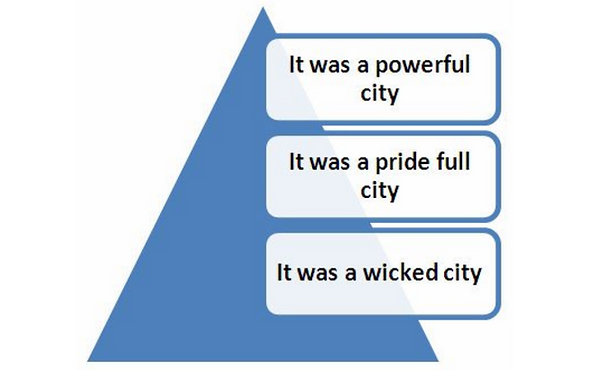
The wickedness of the city Nineveh had made her ripe for the judgment of God. The prophet of God, Jonah the dove was called to cry against the city. The idea being conveyed here is not to whisper the message of God in the back alleys, but rather, publish it in the streets of the city. The prophet would have to preach the judgment of God against the city Nineveh that the people might repent, for their wickedness had come up before God.
THE ACCUSER
Nineveh’s wickedness coming "up before" God was probably due to the accuser known to us as the devil.
The name/title “devil” comes from the Greek word “diabolos” and means “accuser” (Str. G1228). The devil, through our own lust, entices us to sin (cf. James 1: 13-14). Then once we have committed the act of sin, he accuses us before God as sinners ripe for judgment.
In the religion Judaism, from whence Christianity has its roots; the devil bear’s the Hebrew name/title “satan,” which can be translated as “prosecutor.” The Strong’s Hebrew and Greek Lexicon describe Satan this way:
“The evil genius in the later theology of the Jews, who seduces men, and then accuses them and calamities them before God.”
“Satan”, Strong’s Hebrew and Greek Lexicon H7854
In the spiritual realm of reality, God is observed as the eternal all wise ultimate Judge who will judge all sin when the time is ripe. Satan, on the other hand is observed as the accusing chief prosecuting attorney who accuses people of sin. And Jesus is observed as an “advocate”, which is to say, the defense lawyer in the courtroom. And what can be better than having the Judge’s Son as your defense attorney? (Cf. 1 John 2:1 for Jesus being the believer’s advocate).
ACCUSATION AGAINST JOB
Concerning the accusations of the devil, he accused Job before God by expressing, the man of God, Job, was only upright because God kept a hedge of protecting grace around him (cf. Job 1:6-11).
ACCUSATIONS AGAINST CHRISTIANS
The Bible also teaches us the devil also accuse the Christians day and night. But it is written; the Christians overcome his accusations by the blood of the Lamb (cf. Revelations 12:10-11).
A CITY RIPPE FOR JUDGEMENT
But those who are not covered with the Lord’s blood would have a difficult time escaping the accusations of the accuser, and thus, the Judgment of God Almighty. This was the situation with the people of the city of Nineveh.
Nineveh’s “wickedness” had “come up before Him” as did the wickedness of the city Sodom in earlier times, whose judgment resulted in fire and brimstone falling from the sky on the city destroying it and its inhabitance (cf. Genesis 18: 20).
Being the righteous God that our heavenly Father is, wickedness without repentance cannot go unpunished. The cities of Sodom and Gomorrah are perfect examples of this. Sodom and Gomorrah were two neighboring cities in biblical times located at the southern end of the Dead Sea, which God had destroyed for being notoriously wicked (cf. Genesis 10:19-25).
I once heard someone say, although the two neighboring cities were wicked; Sodom and Gomorrah together could not hold a candle to America’s daily sinful acts. I also heard it said, if God does not judge America soon; He will have a need to apologize to Sodom and Gomorrah.
THE CHRISTIAN’S CALLING
What Jonah the dove was called to do, Christians today are called to do as well, i.e., preach against the notorieties being done in their nations, cities, and communities. I mentioned earlier in so many words that Jonah’s name mean “dove,” and a dove was a harmless bird used to deliver messages because of its ability to go out, deliver the message, and then find its way back home without getting caught up in the world. Christians are also called to go out and preach to their nations and communities in the power of the Holy Spirit, who according to the Bible is symbolized by a dove (cf. Matthew 3:16; Mark 1:10; Luke 3:22). It is as if the Lord Jesus is saying to the believers today, the same thing he told the apostle Paul some two thousand years ago:
“But rise, and stand upon thy feet: for I have appeared unto thee for this purpose, to make thee a minister and a witness both of these things which thou hast seen, and of those things in the which I will appear unto thee; Delivering thee from the people, and from the Gentiles, unto whom now I send thee, To open their eyes, and to turn them from darkness to light, and from the power of Satan unto God, that they may receive forgiveness of sins, and inheritance among them which are sanctified by faith that is in me.”
Acts 26: 16-18 – The words of Christ
Jonah’s Disobedience
But Jonah rose up to flee unto Tarshish from the presence of the LORD, and went down to Joppa; and he found a ship going to Tarshish: so he paid the fare thereof, and went down into it, to go with them unto Tarshish from the presence of the LORD. (1: 3)
Just as Jonah was called to proclaim the Word of God; Christians are called to do the same. And just as Jonah rebelled against God’s Word; too many Christians do the same as well. The Bible states, instead of going to Nineveh, Jonah rose up to flee unto Tarshish from the presence of the LORD.
THE OPPOSITE DIRECTION
Nineveh was located around 500 miles northeast of the holy city Jerusalem. But “Jonah rose up to flee unto Tarshish” (seemingly the opposite direction). Tarshish was approximately 2000 miles west of the holy city Jerusalem in what is known today as Spain. This would have seemed at that time to be the very edge of the known world.

WHY DID JONAH RUN?
Jonah’s fleeing to Tarshish was a fleeing from the presence of the Lord. Jonah must have supposed: the further away he got from God’s holy Temple in Jerusalem would be the further away he got from the presence of God Jehovah. To the Jews, in biblical times, their holy Temple at Jerusalem represented the presence of God (cf. Jonah 2:4).
Jonah’s blatant act of disobedience to God’s command has been the discussion of many debates around the world for hundreds of years. What could have been the motive for Jonah rejecting his office and breaking his vows as a prophet of God? What would cause him to deliberately go in what appears to be the opposite direction of God’s desired location for him? Part of the answer to why Jonah did not want to go to Nineveh is found in the people who occupied the city of Nineveh. The occupants of the city Nineveh were the Assyrians. And they were the enemies of Jonah’s people, the Jews.
THE ASSYRIANS
The Assyrians, who were known for the brutalities afflicted on their captives of war, were continually conquering what seemed to be the entire known world at that time. It would have only been a matter of time before Israel, Jonah’s homeland, came up under their radar. The prophet Jonah did not want to preach the judgment of God to them because it might have led to the nation’s repentance, resulting in God not judging and crushing them like He crushed the cities Sodom and Gomorrah and the Egyptian empire in antiquity. Jonah wanted the Assyrians to continue to live in their sins so God would judge and squash these enemies of his people. Jonah did not want the people of Nineveh to experience the forgiveness of his God Jehovah (cf. Jonah 4:1-2). As we shall see, Jonah wanted to keep God’s loving forgiveness reserved for himself and his people, the Jews.
I guess Jonah, like David, longed for wings like a dove (cf. Psalms 55:6) so he could fly away from God and his enemies. But instead of sprouting wings, Jonah found a boat. So, he went down to Joppa (the seaport), and found a ship going to Tarshish: so he paid the fare thereof, and went down into the ship to go with them to Tarshish from the presence of the LORD.
Here, we see in the prophet Jonah what the best of men are when God leaves them to themselves.

WHY DO WE RUN
Instead of doing the will of God, we find Jonah running away from God’s will. Many Christians do the same today. It is called, “out of sight/out of mind”. When we as Christians find something in our Christian contract not agreeable to us, or something is not going our way, we sometimes rebel against the will of God. Not desiring to honor our covenant agreement to Him any longer; we backslide! We feel as Jonah felt, i.e., if we stay far away from God’s Temple (the Church) we are escaping the presence of the Lord.
But is that possible? Can one really flee the omnipresence of the Most-High God? To answer this question, David said in the Psalms,
“Whither shall I go from thy spirit? Or whither shall I flee from thy presence? If I ascend up into heaven, thou art there: if I make my bed in hell, behold, thou art there. If I take the wings of the morning, and dwell in the uttermost parts of the sea; even there shall thy hand lead me, and thy right hand shall hold me.”
Psalms 139: 7-10
The sooner we learn the better off we will be – there is no escaping God. If you are one who belongs to Him, chosen to do His will; take my advice and do what God has called you to do. It is as David expresses in the above Bible verse: no matter how far you think you might be getting away from God, His hand will lead you and hold you.
Because Jonah 1: 3 states, Jonah “went down in” the ship, and Jonah 1: 5 lets us know that while in the ship Jonah had fallen asleep; I often picture him climbing down into the insides of the ship, not being fully aware of the terrible act of sedition he was committing. As far as scriptures concur, no Jewish prophet had ever refused the commission of God. Therefore, I picture the prophet Jonah thinking that he will now get some sound rest. And while falling asleep, I picture him maybe saying to himself,
“Huh, I showed him! That will teach Him to command me to preach to my enemies, those wicked Gentile Assyrian Ninevites.”
The Mighty Storm
But the LORD sent out a great wind into the sea, and there was a mighty tempest in the sea, so that the ship was like to be broken. Then the mariners were afraid, and cried every man unto his god, and cast forth the wares that were in the ship into the sea, to lighten it of them. But Jonah was gone down into the sides of the ship; and he lay, and was fast asleep. So the shipmaster came to him, and said unto him, What meanest thou, O sleeper? arise, call upon thy God, if so be that God will think upon us, that we perish not. (1:4-6)
The Bible states, the LORD sent out a great wind into the sea, and there was a mighty tempest (storm) in the sea, so that the ship was like to be broken up. It is absurd how nature (i.e., the wind) obeyed God’s command, and Jonah would not. Many Christians do not realize it, but we bring a lot of storms into our own lives by being disobedient to God’s will.
NO ORDINARY STORM
God sent a mighty tempest (storm) into the sea at the behest of Jonah’s disobedience. Let the reader understand, this was no ordinary storm God sent Jonah’s way. The mariners (sailors) who more than likely were experts at maneuvering on the sea; and had encountered many storms had even become afraid of this storm; in so much so, cried every man unto to his god.
The sailors, being pagans, would have worshiped many gods. Therefore, in desperation, each turned to his own god in hopes of bringing the horrific storm to an end.

SEARCH FOR COMFORT
What a crying out for God us Christians undergo in the time of trouble and distress! How self-controlled we are (in many cases not talking to, or even acknowledging God) when there is no trouble in sight. But oh, how our attitudes instinctively change when we are in great agony!
Like the pagan sailors turning to their gods of comfort in fearful times, many people of the world do the same. When caught in the storms of life, people of the world naturally turn to their gods of comfort: i.e., the god of drugs, the god of alcohol, etc. But when these same people come down off their high (i.e., their brief escape from reality), they realize the storm is still raging on and in some cases have gotten worse.
OUR DISOBEDIENCE AFFECTS OTHERS
The sailors, in the terrible jam that they were in, had even begun to through their cast forth the wares that were in the ship into the sea, to lighten it of them. This is to say, the sailors had begun to cast their cargo that was in the ship into the sea to lighten the load. The sailors throwing cargo overboard would have been like throwing money overboard because; their cargo was their lively hood.
When we bring storms into our lives because of disobedience; the storms often affect the people around us. Because of Jonah’s disobedience, the people around him (the sailors) suffered.
“The bad man never suffers alone. Here is a man causing a loss of property. He paid his fare! Oh, it was poorly earned money! His fare was taken out again. They cast the wares into the sea; they said, "She is too heavy; she must be disburdened; we must throw away whatever we have—away it all must go!" The bad man cannot suffer alone; the bad man is the tormentor society; wickedness is the cause of social loss. It is madness for any man to rise-up and say, "In doing an evil deed, I am injuring no one but myself. You are injuring everybody. You are causing loss to the universe itself.”
“Jonah 1: 4” The People’s Bible, by Joseph Park
Seeing that Jonah was a paying passenger (cf. Jonah 1:3), he was not required to work. Thus, he was in the sides of the ship (lowest parts of the ship) where his quarters were. And he was more than likely fast asleep when all the commotion was going on. Jonah being “fast asleep” denotes the insensitivity and dullness of the ear to the crying out of the world, and the will of God.
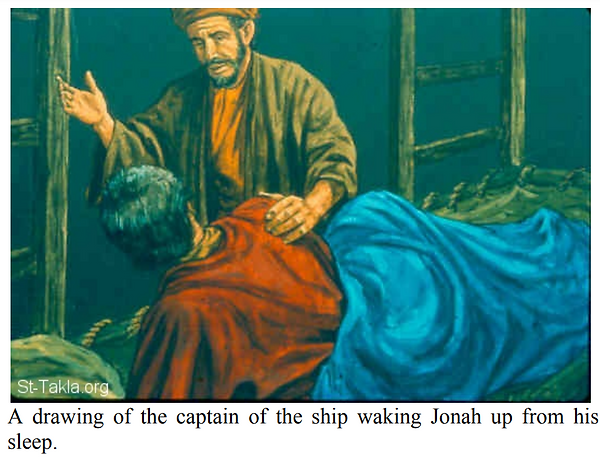
While the prophet Jonah “was fast asleep” the captain of the ship, who probably was looking for more cargo to toss overboard to lighten the ship came across Jonah who was asleep. He awakened him and said to him, What meanest thou, O sleeper? This is to say, “Why are you sleeping?” He then said to Jonah, arise, call upon thy God, if so be that your God will think upon us, that we perish not.
As mentioned earlier, the sailors were pagans and believed in many gods. Therefore, the captain awakening Jonah and asking him to pray to his god would seem normal, seeing that the captain’s god and his crew’s gods were not putting a stop to this out-of-control storm.
